

Tooth loss impacts much more than appearance. It affects how you chew, speak, and smile — often leading to poor nutrition, lower self-confidence, and even premature facial aging. For decades, traditional full or partial dentures were considered the go-to solution. But advancements in implant dentistry now provide more functional, aesthetic, and long-lasting options.
Among these, implant-supported bridges stand out as a transformative solution for patients missing multiple teeth. Unlike removable dentures, implant bridges offer fixed stability, preserve bone structure, and look and feel like natural teeth.
This article explores how implant-supported bridges compare to traditional dentures in function, comfort, aesthetics, cost, and long-term oral health.
What Are Traditional Dentures?
Traditional dentures are removable dental appliances made from acrylic or acrylic combined with metal. They are designed to rest on the gums and mimic the function of missing teeth.
Types of Traditional Dentures:
- Complete dentures (full arch replacement)
- Partial dentures (replace a few teeth)
- Immediate dentures (used after extraction)
Limitations of Traditional Dentures:
- Lack of stability — often shift or click during eating or speaking
- Dependence on adhesives
- Frequent relining due to tissue changes
- Altered taste due to palatal coverage
- Reduced chewing efficiency (15–20% of natural force)
- Accelerated bone resorption leading to sunken facial appearance
What Is an Implant-Supported Bridge?
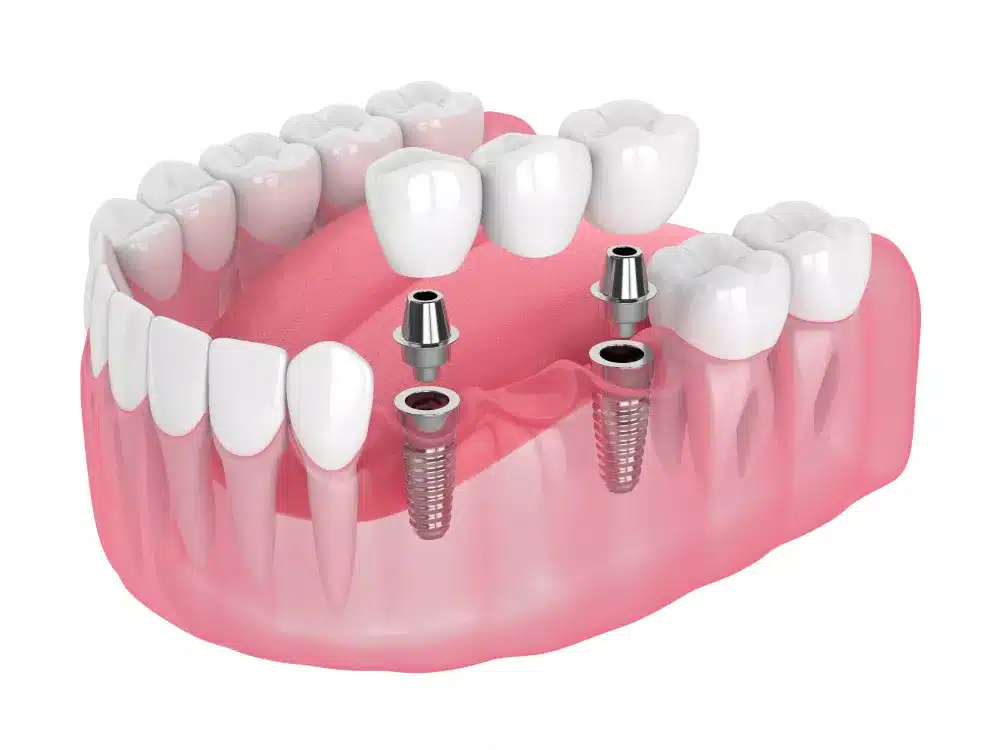
An implant-supported bridge is a fixed prosthesis anchored directly to dental implants placed in the jawbone. Instead of relying on surrounding natural teeth or gum tissue, it gains support from titanium implants that fuse with the bone (osseointegration).
Advantages of Implant Bridges:
- Fixed and non-removable
- Support from bone, not gums
- Restores 80–90% of chewing power
- Prevents jawbone loss
- Doesn’t require grinding healthy teeth (unlike traditional bridges)
- Highly aesthetic and natural appearance
- Lasts 15–20+ years with proper care
Clinical Comparison: Implant Bridge vs Traditional Denture
|
Criteria |
Traditional Denture |
Implant Bridge |
|
Support Mechanism |
Gum-supported |
Implant-supported |
|
Stability |
May shift or loosen |
Firm and fixed |
|
Chewing Power |
15–20% of natural strength |
80–90% of natural strength |
|
Bone Preservation |
No — bone loss continues |
Yes — stimulates bone |
|
Aesthetics |
Often artificial looking |
Very natural-looking |
|
Comfort |
May cause sore spots |
Feels like natural teeth |
|
Longevity |
5–8 years |
15–20+ years |
|
Maintenance |
Frequent adjustments needed |
Minimal maintenance |
Why Dentures Often Fail Over Time
Traditional dentures are not anchored to bone — they rest solely on soft tissue, which changes shape over time. As the jawbone shrinks, dentures loosen, requiring constant relines or full replacements.
Common issues include:
- Difficulty chewing fibrous or hard foods
- Discomfort or sores from pressure points
- Self-consciousness when speaking or laughing
- Decreased dietary variety, leading to poor nutrition
Over time, many patients grow frustrated and seek more permanent, reliable alternatives — like implant bridges.
Benefits of Choosing an Implant Bridge
1. Natural Chewing Ability
Implant bridges offer bite force similar to natural teeth, restoring chewing efficiency and allowing you to enjoy your favorite foods again.
2. Prevents Bone Loss
Implants stimulate the jawbone, preventing atrophy and maintaining your facial structure.
3. Preserves Neighboring Teeth
Unlike traditional dental bridges, implant bridges don’t require grinding down adjacent healthy teeth for support.
4. Confidence and Comfort
Implant bridges don’t slip, click, or fall out. You can speak and laugh confidently, just like with natural teeth.
5. Long-Term Cost Efficiency
Although initial investment is higher, implant bridges last longer and require fewer replacements — saving money over time.
Cost Comparison — UK vs Turkey
|
Treatment |
UK Price (Avg) |
Turkey Price (Avg) |
Savings |
|
Traditional Full Denture |
£1,200 – £2,500 |
£500 – £900 |
Up to 60% |
|
3-Unit Implant Bridge |
£3,000 – £5,000 |
£1,200 – £2,000 |
Up to 70% |
|
Full-Arch Implant Bridge |
£8,000 – £14,000 |
£2,800 – £4,500 |
Up to 70% |
Why is Turkey more affordable?
Due to lower operational costs and the competitive pricing model of medical tourism — not a compromise in quality.
Who Is a Candidate for an Implant Bridge?
Missing multiple teeth
Sufficient jawbone density (or willing to undergo bone grafting)
Good general health
Committed to oral hygiene
Non-smoker (or willing to reduce smoking)
What to Expect — Treatment Journey
1. Consultation & Planning
- CBCT scan, intraoral scan
- Digital Smile Design
- Full medical history review
2. Implant Surgery
- Local anesthesia or sedation
- 2–4 implants placed
- Healing caps added
- Procedure time: 1–2 hours
3. Healing Period (8–12 weeks)
- Osseointegration (bone fuses with implant)
4. Final Bridge Placement
- High-aesthetic zirconia or porcelain bridge
- Permanent cementation and bite check
Why Choose Dental Harmony Turkey?
✅ Experienced implant team with 5,000+ procedures
✅ Straumann & Nobel Biocare implants
✅ CBCT-guided digital surgery
✅ In-house CAD/CAM lab for fast production
✅ Transparent, fixed-price treatment packages
✅ Accommodation, transfers, and aftercare included
✅ Multilingual team & ISO-certified sterilization standards
Restore Function, Stability, and Confidence
If you’re tired of loose dentures or missing teeth, an implant-supported bridge could be your solution to eat, smile, and speak with total confidence.
Contact Dental Harmony Turkey today for a free treatment plan and expert assessment.
Frequently Asked Questions (FAQ)
Q1: Is the implant bridge procedure painful?
No — it’s done under anesthesia or sedation. Mild soreness may occur post-op.
Q2: Can smokers get implant bridges?
Yes, but heavy smoking increases implant failure. Reduction or cessation is advised.
Q3: How long does the whole process take?
From consultation to final placement: 2–4 months.
Q4: What materials are used for the bridge?
Zirconia, porcelain-fused-zirconia, or titanium-reinforced hybrid materials.
Q5: Will I be without teeth during healing?
No — a temporary bridge is provided during the healing phase for function and aesthetics.